Dr. Austine Emifoniye: Research and Practice | Artist Interview
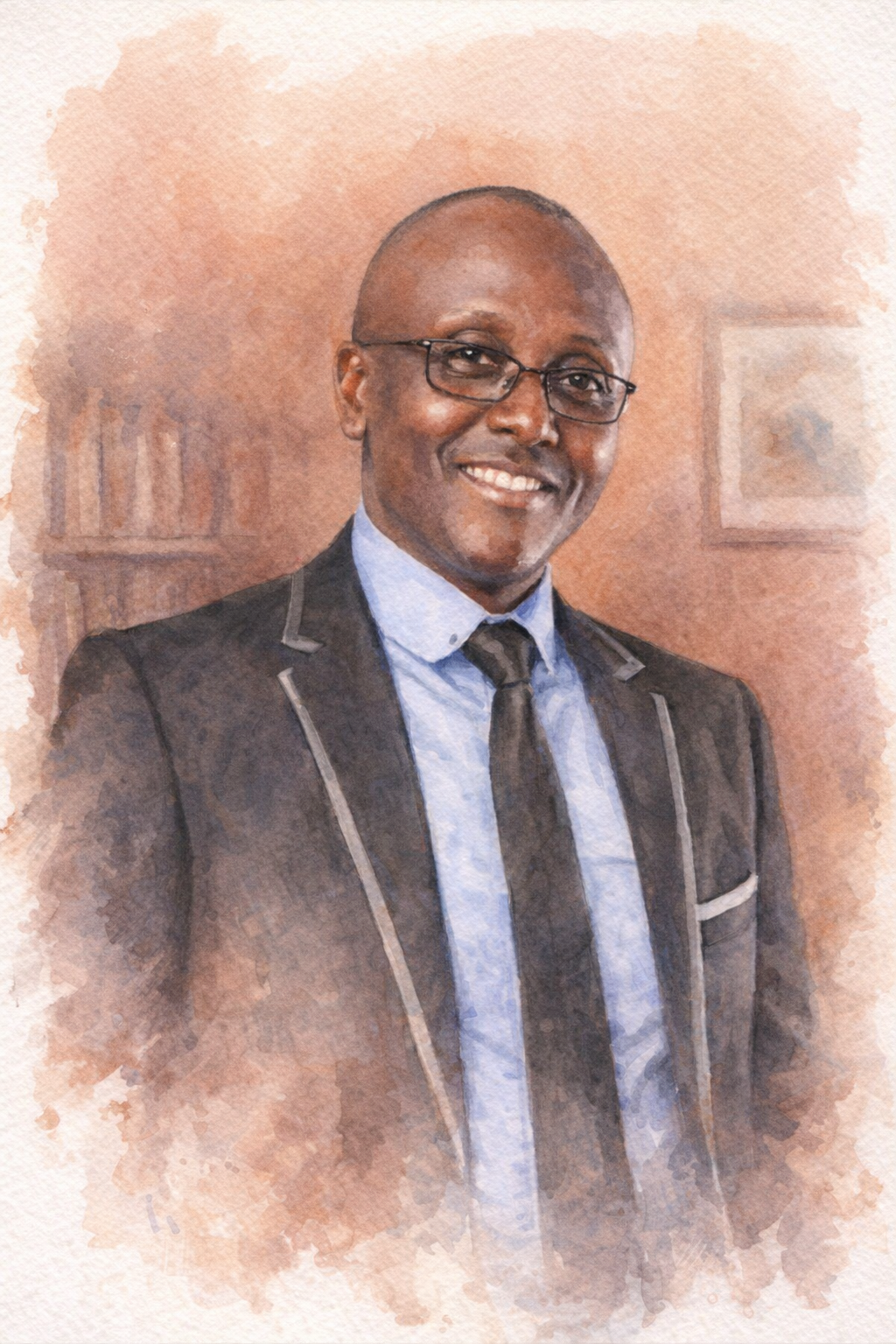
Dr. Austine Emifoniye could have been an engineer - or at least that’s what his parents initially hoped for. During his childhood days, he was drawn to creation and working with his hands, joining wires, picking up scraps, trying to fix mechanical and electrical appliances at home. However, his creative inclinations brought Austine not to sciences, but to the arts. Today, Austine is not only an artist, but an arts professor with a PhD in visual arts. Restless researcher, Austine shared his creative path.
Due to his inclination toward research, Austine has always been experimenting with mediums. He started out in the visual arts as a sculptor, but under this label, he refused to choose a basic material. “I want to work with new materials and with existing materials. I would like to see how I can stretch the potentials of a particular medium and what can be added.” For his more recent large outdoor sculptures, Austine has been using polyester casts, but he often has introduced some other materials to form a composite. His very last 12-feet outdoor sculpture was made with what he calls “poly-wood composite,” a composition of polyester resin and wood dust. The end result bears external characteristics of wood, showing patterns of grain while preserving the qualities of polyester to withstand the environmental forces an outdoor sculpture would face. Similarly, Austine has composites of polyester and marble, which he termed “poly-marble” to simulate appearance of marble without carving an actual boulder, but with the flexibility of the fluidity and casting potential that resin provides in the art making process. “What I do is to see how I can enhance existing properties of materials and use them for my work”. I had to ask Austine about why, out of all possible mediums, he came to sculpture and still has a preference for it. The artist explained that to him, sculpture provides multiple range of experiential connections and experimentation. “In a three-dimensional sense, it is the evaluation of both tactile and visual qualities that endeared me to sculpture. While painting for instance, will show you just a view of the arms, in three-dimensional sculpture, you want to look at the back and the sides as well. How does it fit, the proportional relations between parts, the dimensions, volume, compositional balance, texture: is it rough or smooth?” I find the mental interaction I have with these properties quite stimulating when working on three-dimensional sculptures.
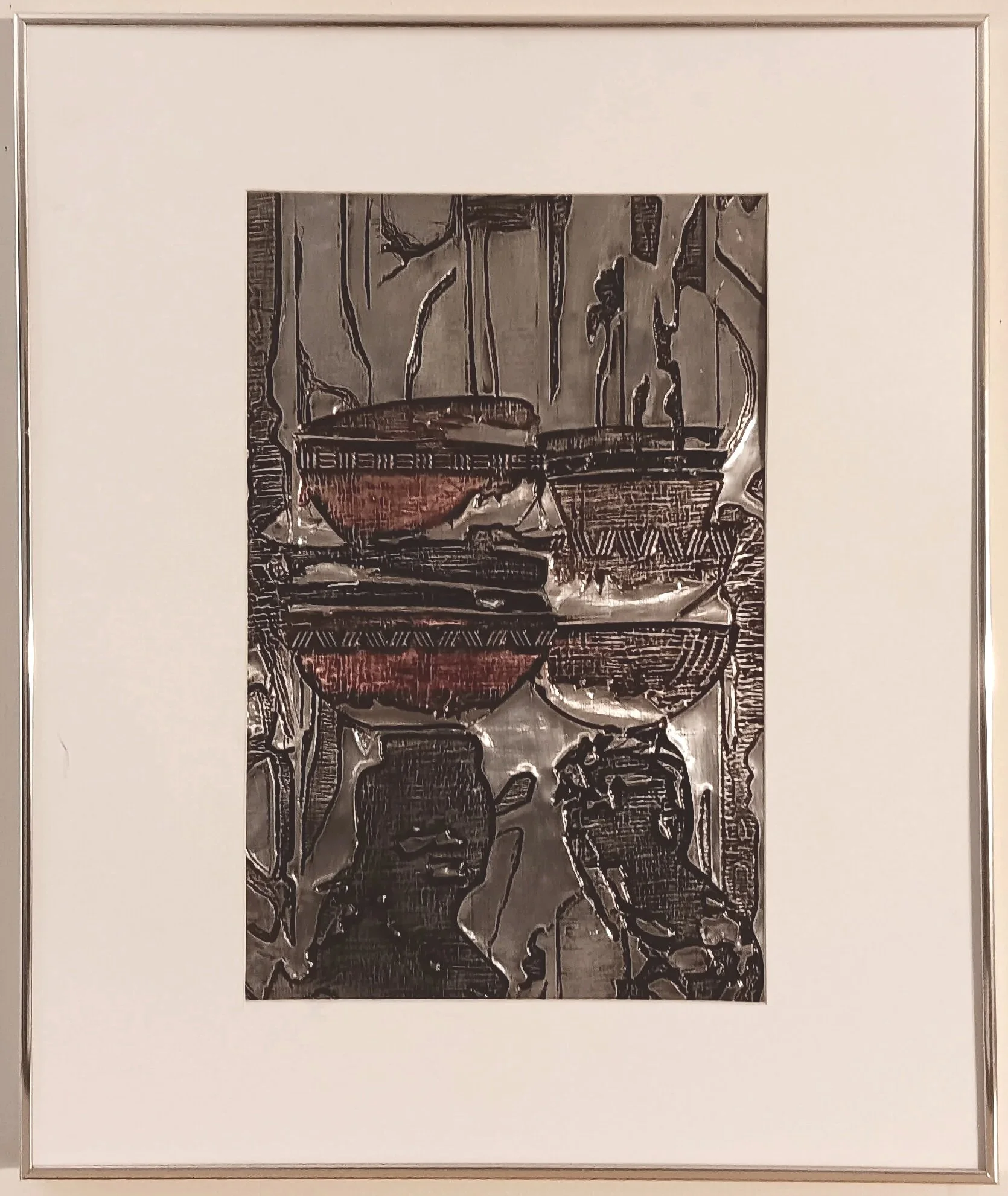
Bread Winner 2, Aluminum Repose, 40 × 60 centimeters
Austine is currently experimenting with aluminum repoussé, which is a technique that consists of shaping aluminum sheets to achieve the desired shape. Although metal repousse is not a new form of art, Austine’s devised the use of laser engraving machine and a matrix to enhance his repousse. In some of his recent works, he printed his sculptural repousse in two-dimensions. In addition (to avoid limiting himself), he has been exploring printmaking, and digitally printed sculptures with 3D software and printers. Austine suggested that he is not the type of artist to stop creating because he does not have access to familiar materials, he is the one who is ready to adapt to the environment and the circumstances provided to him. Austine’s adaptability has helped him in the United States, although he does not yet have a large studio with the materials and instruments needed for the large sculptures as he did in Nigeria, he finds new ways of exploring and enhancing his art practice. “I look around me to find out what I can use”, Austine smiles. Currently, he has been focusing on the smaller pieces compared to his previous practice. “I don’t have my dream studio yet in the US, so I cannot really go into the monumental kinds of sculptures that I did in Nigeria.” The artist shared that, given the opportunity, he would keep working on large sculptures, and warmly described his large studio space in Nigeria. For him, it’s not the equipment he reminisces about, but the amount of space he needs to work on the projects. “For us sculptors, the most important facility is the space. The space has to be large enough for you to get the expression that you want to get out”.
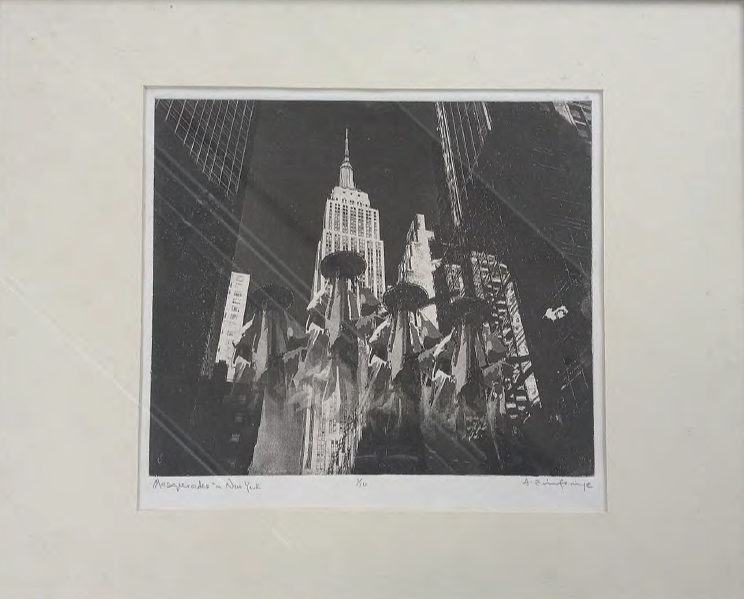
Masquerades in NYC, Aquatint Print, 40 × 50 centimeters
As we’ve learned, Austine finds inspiration in the environments he finds himself in and his practice is guided by the things that are available to him, while been influenced by his background and his present environment. “I’m an African, and I grew up and schooled in the ancient city of Benin, an area where artistic practice has been going on for several centuries.” He reminisced how those two inspirations combined when he visited New York City for the first time: the skyscrapers he saw on Broad street reminded him of Broad street in Lagos, Nigeria. In Lagos, there is a traditional masquerade called Eyo and the similarity of the cityscape led him to create the aquatint print “Masquerades in New York City” (above). It blends the memories of Lagos culture with the cityscape of New York. “I’ve not really stayed on a particular theme and explored it continually. As I come across new concepts, my art form tends to evolve with that because I am a researcher, and I need that level of independence and versatility to teach others”. However, over the years, I have explored concepts of feminism, humanism, and African life. Developing new concepts for Austine naturally comes from having to interpret the environment he finds himself against his cultural background. The artist also shared that the perception of a new place changes significantly when you spend more time in it. He notes that his previous short visits to New York city are incomparable with his experience living in New York city and as professor at Pratt Institute.
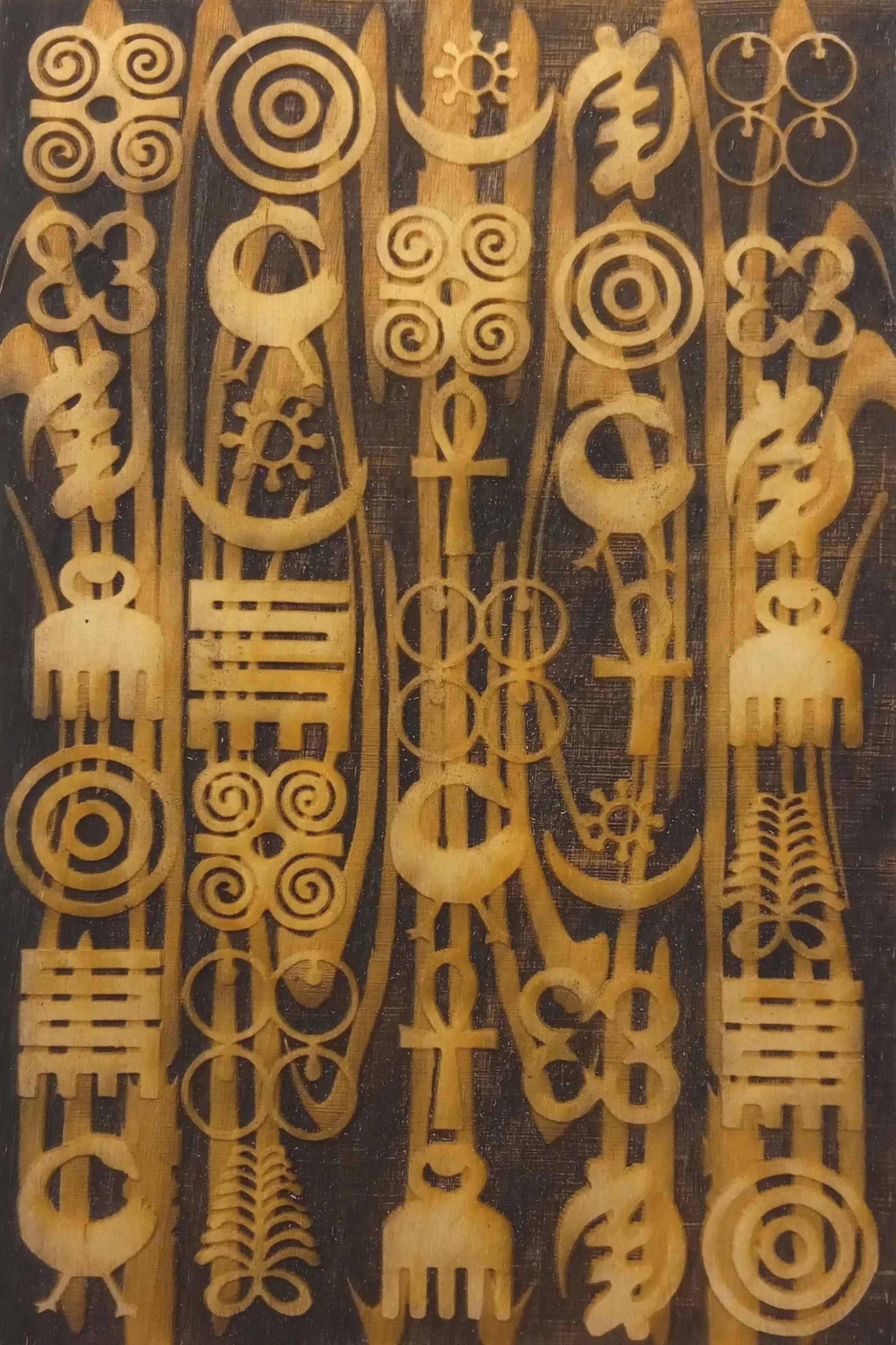
Vernacular Patterns, Wood, 30 × 50 centimeters
The artist also shared his ideas about the importance of museology to his art. He believes that Museum Studies gave him a good grounding both as an art historian and an artist. “Museology makes you think further about the future of the works of art”. While his background taught him to create and teach art, museum studies made Austine more aware of the effort that goes into preservation and care for artworks, artefacts and other cultural objects. It gave him another perspective that he keeps in mind while teaching and working on his artistic practice, as well as the reflections he has put into many of his recent publications in scholarly journals.
While teaching at Syracuse University, and Pratt Institute in the United States, Austine has met a lot of other great artists. At the University of Lagos, and Delta State University both in Nigeria, where he taught previously, he says there are many great artists too. I got to peek into his current artist inspirations and even an upcoming project. Austine shared that as of the moment, he is writing a book on a prolific artist that he believes should get recognition because of his unique style of expression and personality. He knows the artist personally and has provided mentorship and still do as the book project evolves. Austine intriguingly preferred not to share the name of the artist yet as the project is still a work in progress. We will be looking forward to learning more soon! Austine also hinted at the last exhibition he took part at the Pratt Institute where he exhibited some of his works in aluminum repousse.
Ultimately, Austine finds joy in teaching. He not only teaches at a collegiate level but also teaches art as an outreach in many ways. He is a distinguished fellow of the Global Arts in Medicine Fellowship (USA), and visioner of the Creative Arts in Medicine Initiative (CAMI). One of his outreaches was at the St. Camilla’s Health and Rehabilitation Center in Syracuse, Upstate New York, where he organized an art workshop for residents over a three-week period with a group of volunteers. He believes that sharing his skills with others and helping others to realize their artistic potentials is one of the biggest assets he possesses. After talking to Austine, I have a strong impression that he might have more than 24 hours in a day: research, teaching, learning, his own art practice… and we are here to see what the many other things one of the most versatile artists we’ve met will come up with soon.
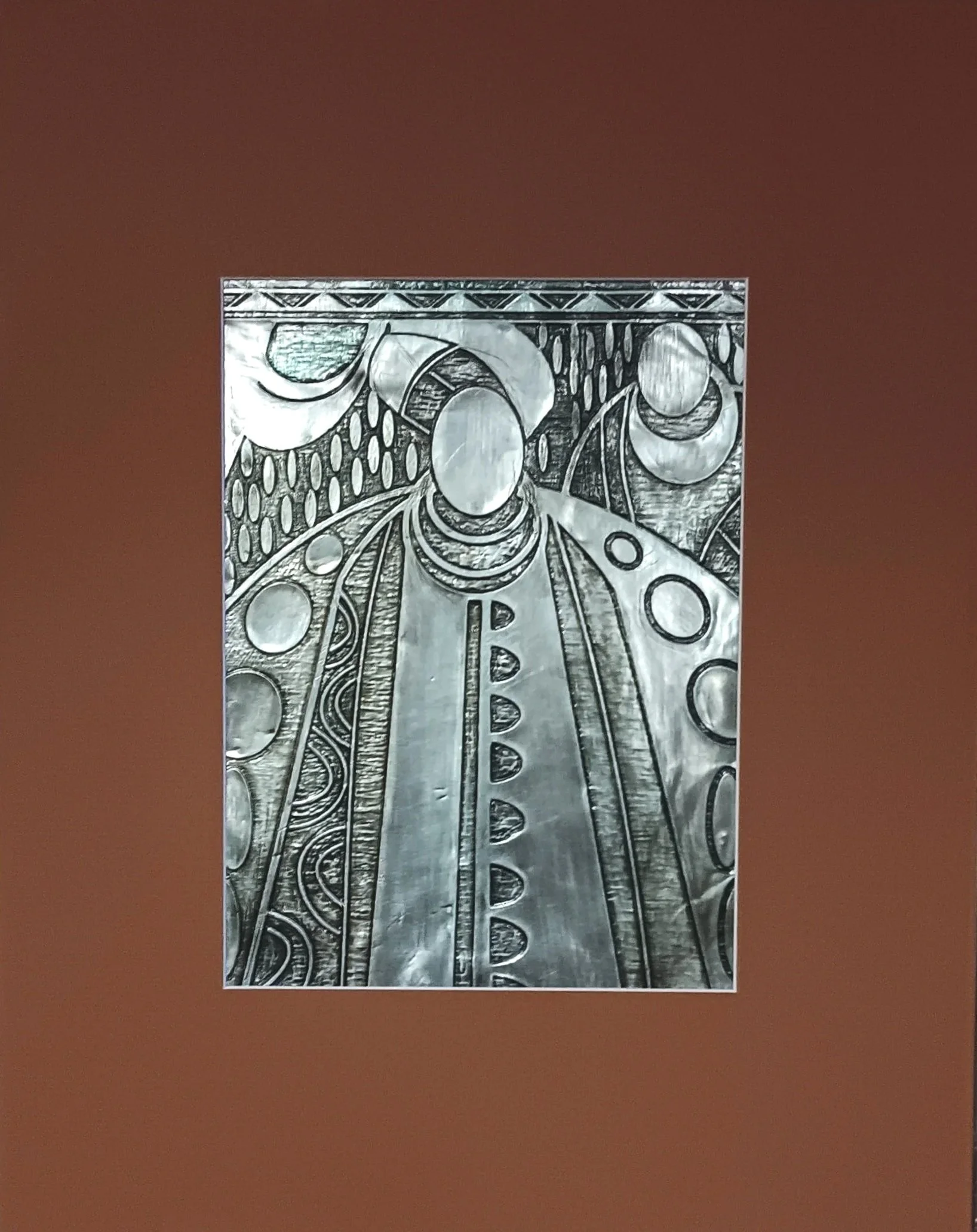
Royal Procession, Aluminum Repose, 40 × 50 centimeters
Linkedin - Dr. Austine Emifoniye PhD.